On the night of 28 to 29 May a Russian drone came down on a residential block in the Romanian city of Galați. A few days later Romania signed an arms contract worth billions of euros that, just a week earlier – through the mouth of its own minister – it had refused to sign. Hardly anyone connected those two dots, yet together they form a simple and uncomfortable thesis – the best salesman the modern arms industry has is not some engineer or lobbyist, but fear. And we are watching that salesman close the deal right now.
The Romanian scenario, or how the price climbs as the clock ticks down.
Let's start with the money, because that is where everything here begins. The EU has launched the SAFE instrument — Security Action for Europe — a pool of €150 billion in cheap, long-term loans for joint arms purchases. Romania received the second-largest envelope in it, close to €17 billion, right behind Poland. And here the thing worth remembering begins, because these are literally the final days. Romania's defence minister Radu Miruță publicly complained that when it came to signing, the suppliers came back with a price about thirty percent higher, and announced that he would not give in to time pressure. To put it plainly — someone realised that an EU deadline was ticking down over the contract, and cranked up the rate accordingly. These are not negotiations, this is the Grand Bazaar in Istanbul.
And it is at precisely this moment that the drone appears. On the night of 28 to 29 May a Russian Shahed, one of a swarm heading for the Ukrainian port of Izmail just across the river, crossed the border and struck the roof of a six-storey block in Galați. Two people injured, a fire in an apartment, two F-16s scrambled. The Romanians have now counted the twenty-eighth violation of their airspace since the start of the war. And the European comment after the incident was a single one — you must make up for lost ground on counter-drone defence, it cannot be that you don't have these systems. And what happens within a few days? The deal rejected a couple of days earlier is signed, just before the EU deadline runs out. Officially it was the calendar that closed it. But it is hard to escape the impression that what really closed it was fear.
I am stating this clearly, because I do not throw such words around lightly. I am not claiming that anyone planned this drone with the contract in mind — it was a Russian strike on a Ukrainian port, and an investigation confirmed the machine's Russian origin. But the very question of who found this incident convenient and who profited from it is entirely legitimate. Because the upshot is that Romania today has systems on order that it does not physically have yet, at a price its own minister had called extortion just a week earlier. They are supposed to have them. I like that phrasing, because it captures perfectly how little actually changed in their security from one day to the next, and how much changed on the invoice.
What was actually bought, or a system that doesn't exist yet.
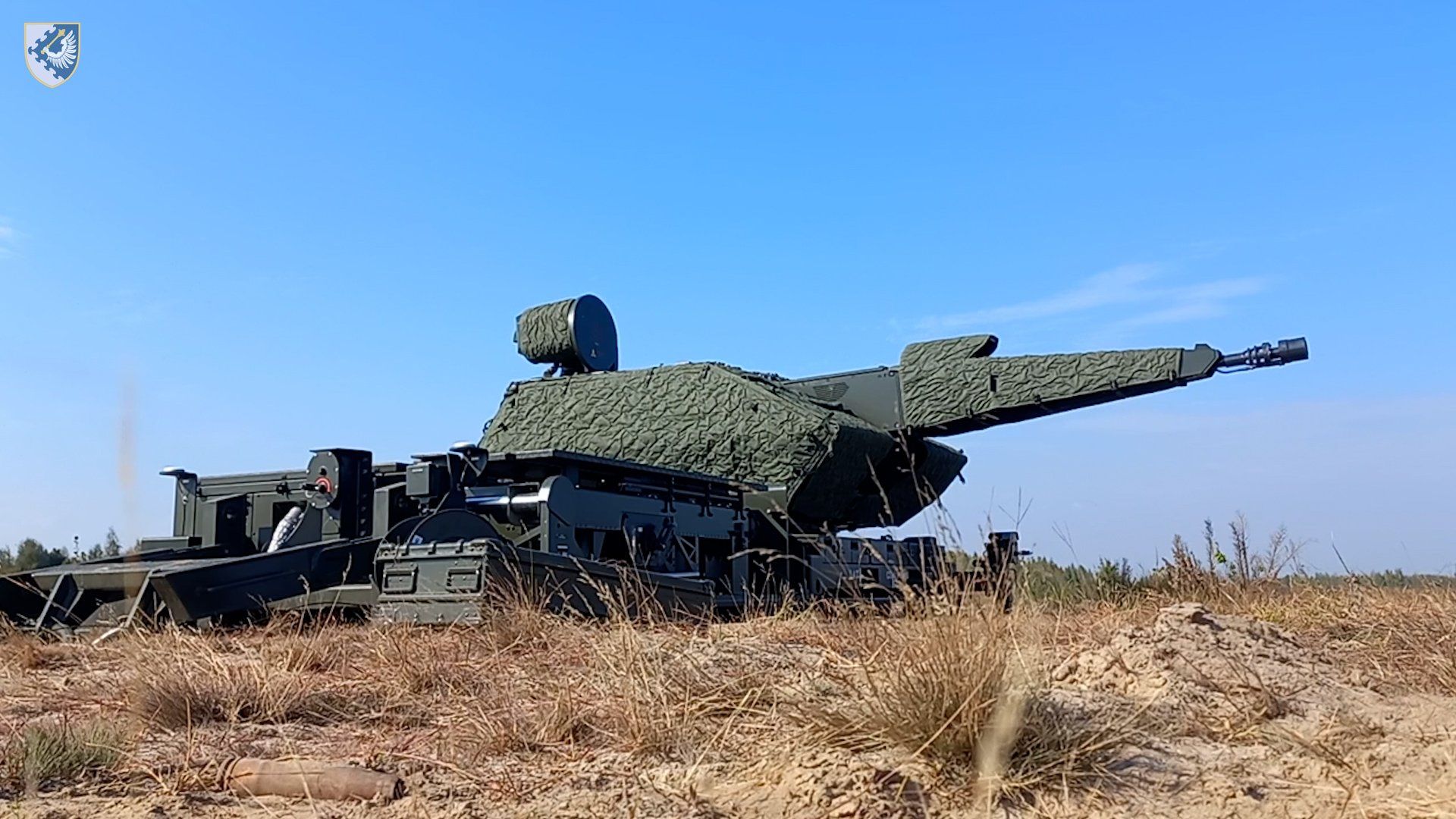
Let's be fair about the hardware, because that part is genuinely good. Under a package worth around €6 billion, Rheinmetall will deliver to the Romanians, among other things, seven Skynex sets and two Skyranger — these are truly solid anti-aircraft and counter-drone systems, knocking down a cheap drone with a thirty-five-millimetre round with a programmable fuze, and therefore far more cheaply than with a missile. The problem does not lie in the hardware. The problem is that years pass between the signature and the first battery that actually defends the sky, whereas fear and the invoice act instantly. The same mechanism worked first in the Baltic, then in Romania — tit for tat, another signal, another signature. The drone became a message, and the message became a sales tool.
The strike on Galați is also a message to Duisburg.
And now let's look at this from my old vantage point, because ports happen to be something I know a thing or two about. Galați is not a random town on the map. It is Romania's largest river-sea port on the Danube, the place where seagoing ships entering through the delta from the Sulina side unload their cargo onto river barges. And from here there is already a straight route upstream — along the Danube, through the Main-Danube Canal, onto the Rhine, all the way to Duisburg, the largest inland port in Europe, through which more than a hundred million tonnes of cargo pass each year, a scale on the order of our Gdańsk. That is why, to me, a strike on the lower Danube is not just a blow to Romania. It may also be a message sent further along this watery artery, towards Germany — a signal that Russia is able to reach the vital transport backbone of all of Europe. That is my interpretation, one of the possible ones, but connecting these dots has its justification.
Don't trust a single valuation.
There is also a second layer to this story, a purely financial one. Rheinmetall's shares have risen roughly tenfold since Russia's assault on Ukraine. Deutsche Bank maintains a "buy" recommendation with a target price on the order of €2,100. It sounds wonderful — except that the stock itself, after a weaker first quarter this year, has slid from around €2,000 to roughly €1,200. And here is my appeal — do not take one single, essentially marketing valuation from one bank as gospel. The Frankfurt exchange is under the watchful eye of American, Chinese and Japanese funds, and it is they, not a Deutsche Bank announcement, who will eventually bring that price back to reality.
Because valuations can be a tool, not revealed truth. We remember how, during the pandemic, Lufthansa was going down in flames and could be had for a pittance, and yet the Merkel government put up €9 billion and decided that the national carrier had to remain German — after which the state exited that investment at a profit. France did exactly the same with Air France. And on the other hand we have our own lesson. In 2009, in the middle of the crisis and at a time when Russian suitors were also circling the privatisation of Lotos, that same Deutsche Bank slashed the valuation of the Gdańsk company to seven złoty. One moment the same bank pulls down, the next it pulls up. That is why we should approach every recommendation like professionals — with a pencil, not with faith.
The most expensive adviser
Let us reduce it to one thing. The threat is real — Russian drones over NATO territory are no fantasy; Poland experienced it too, when last September incoming machines had to be shot down over our country. The need for counter-drone defence is genuine and urgent. But that is precisely why we must not buy under the influence of fear, in the shadow of a single incident, a single marketing valuation and a ticking EU deadline. That is a straight road to overpaying for systems that don't exist yet. The Romanian minister who insisted on a fair price and on local content was doing exactly what should be done. Let's buy a lot and let's buy fast, because time is short — but let's buy cool-headedly, because we have done the maths and we know we need it, and not because someone has just waved a drone in front of our eyes. Fear is the most expensive adviser one can hire.
In this piece I draw on the European Union regulation establishing the SAFE instrument from May 2025 and on the allocations granted under it, on reports of the Romanian-German arms contracts and the dispute over their price, on the circumstances — confirmed by the Romanian side — of the Russian drone strike on Galați at the turn of May and June this year, on data for the ports of Galați, Duisburg and Gdańsk and the course of the Rhine-Main-Danube waterway corridor, on the share price and recommendations for Rheinmetall, and also on the history of state aid for Lufthansa and Air France and on the 2009 valuation of Grupa Lotos.