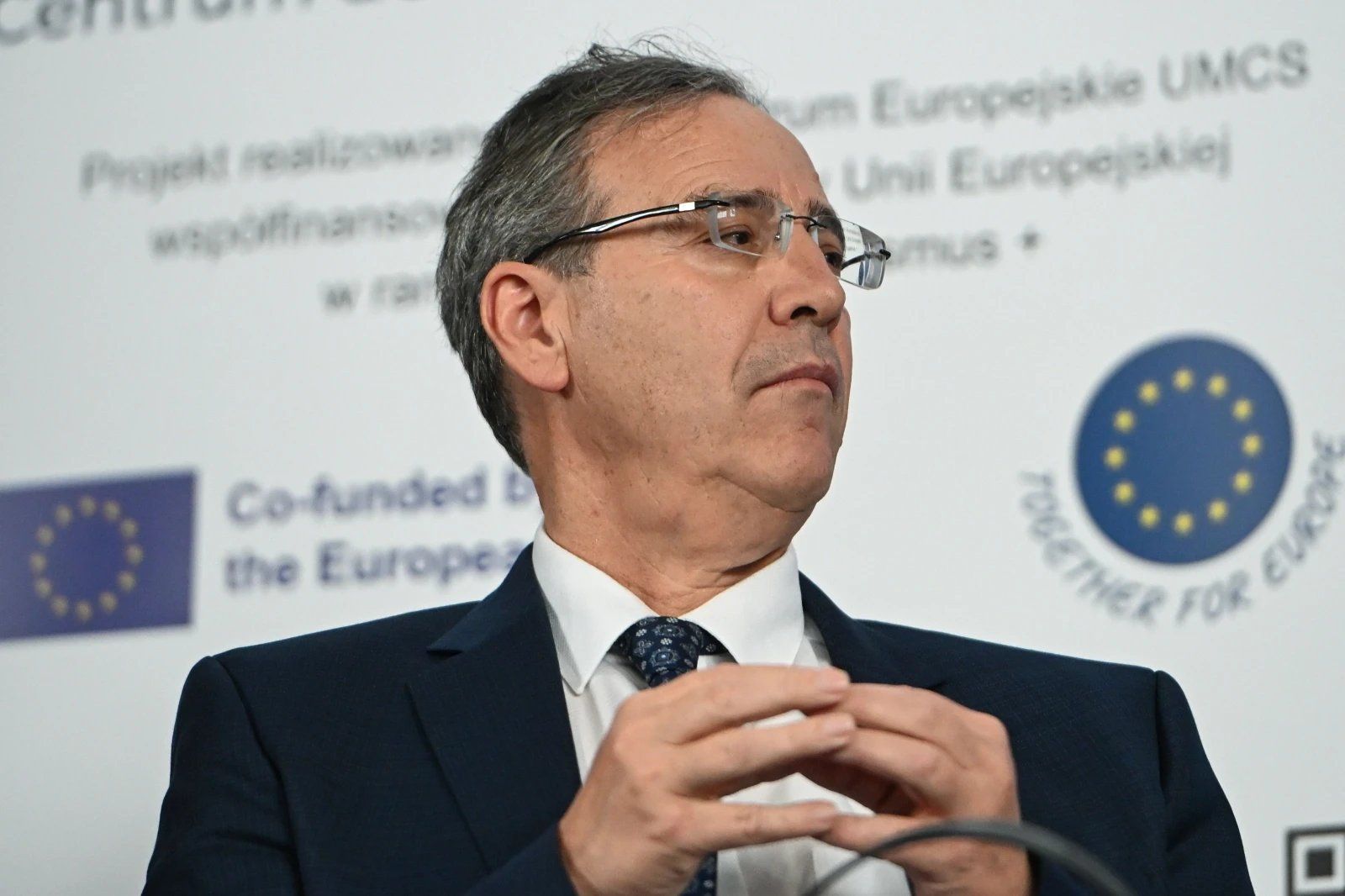
June 2026 marks the 35th anniversary of the signing of the 1991 Polish-German Treaty on Good Neighborliness and Friendship. On this occasion, Warsaw and Berlin were originally to sign a new defense agreement. German Ambassador Miguel Berger, in an interview for TVP World, sought to argue that the agreement reached in place of a treaty is a natural step in deepening many years of cooperation, rather than a replacement of the treaty foundation.
Berger stressed that from the outset the talk had been solely of a “defense agreement,” and not of a new treaty. In his view, the 1991 treaty remains the “foundation” and does not require replacement. This is a convenient narrative for the German side. The 1991 treaty was created in an entirely different era, at the moment of the fall of the Berlin Wall, the unification of Germany, and Poland's systemic transformation. The world looked different back then, because Russia was weak, NATO was not fighting for survival on its eastern flank, and the hybrid and cyber threat did not have today's scale.
The comparison to Poland's agreements with the United Kingdom, which appears in this interview, is also mistaken, because with London a clause was signed referring to NATO's Article 5, a so-called mutual-defense mechanism. Berger explains that in relations with Germany (and within the EU) this is not necessary, owing to Article 42.7 of the Treaty on European Union, which is “even stronger.” These are elegant evasions. In practice, Article 42.7 has never been seriously tested under conditions of a real conventional conflict on the scale of the war in Ukraine. The British, after Brexit, clearly wanted to put something concrete down on paper. The Germans prefer to stick to the EU framework, where decisions are blurred, require consensus, and leave room for political maneuvering. Poland, as a frontline country, should demand clear, bilateral guarantees rather than relying on EU bureaucracy.
The new agreement is meant to introduce a “structure” of cooperation — Berger maintains — regular meetings of ministers and of the commands of the branches of the armed forces, cooperation in cyberspace, military mobility, and the defense industry. Berger cites the Patriot systems in Rzeszów, the Eurofighters in Malbork, and the German brigade in Lithuania as proof of success.
The German brigade in Lithuania is an important element of deterrence, but its full operational readiness is still far off, and its deployment raises questions in Poland about the real protection of the eastern border. Military mobility across German territory remains crucial, because Germany is NATO's logistics hub. History shows, however, that at moments of crisis Berlin has at times been wavering.
Berger assures that this cooperation “will absolutely suffice” in the face of the Russian threat. Russia is waging a war of attrition, testing NATO at every level, from drones to disinformation. The German “Zeitenwende” announced by Scholz in 2022 still remains, to a large extent, merely a declaration. Germany still has trouble reaching 3.5% of GDP on defense in a sustainable manner, and its arms industry suffers from chronic delays and bureaucracy. Poland, which spends close to 4% of GDP on defense and is genuinely modernizing its army, has the right to expect more from a partner on the western flank than “structures of cooperation.”
Ambassador Berger claims that cooperation with the USA and with Germany are not mutually exclusive. That is true at the level of declarations. In practice, Poland rightly fears that too close a tie to German initiatives, including within the EU, could weaken the transatlantic relationship, which remains the most important guarantor of security for Poland. Berger stresses that the USA will be reducing its presence in Europe. For years Germany benefited from the American umbrella while at the same time pursuing an economic policy that increased the threat to all of Central Europe.
A separate thread is the restitution of works of art. Berger highlights the handover of medieval documents of the Teutonic Order — gestures that are symbolically important, especially in the context of historical debates. Poland, however, is still waiting for real progress on works looted during the Second World War, in the context of broader claims. A continuous dialogue of experts is needed, but 80 years after the end of the war, the pace and scale of returns remain disappointing.